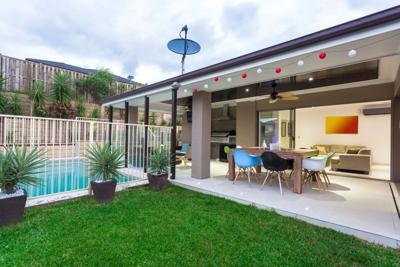


Photo provided by DepositPhotos
Something strange happened in residential real estate over the last few years. The backyard, once an afterthought sandwiched between a fence and a forgotten grill, quietly became the most expensive room in the house. And it's not even indoors.
High-income homeowners aren't just sprinkling money on a few potted plants and a fire pit anymore. They're commissioning full-scale outdoor living environments with budgets that would've bought an entire house a generation ago. The question isn't whether people are spending big on outdoor spaces. It's why the numbers keep climbing, and what that tells us about where luxury homeownership is headed.
The Numbers Behind the Trend
The 2025 U.S. Houzz & Home Study, which surveyed nearly 22,000 respondents, found that homeowners in the 90th percentile spent $140,000 or more on renovations. Gen X renovators led the luxury tier, with the top 10% spending $150,000 or more on their projects. Baby boomers and millennials in that same bracket weren't far behind at $125,000 or more each.
People are also reading…
And where is a significant chunk of that money going? Outside. The same study found that more than half of renovating homeowners (53%) enhanced their outdoor spaces in 2024, completing nearly two outdoor projects on average.
When more than half of renovating homeowners are putting money into outdoor projects, it stops looking like a trend and starts looking like a line item.
The budget typically breaks down across four major categories: pools and water features, architectural structures like pergolas and pavilions, professional landscaping, and integrated lighting and audio systems. Of these, permanent structures tend to carry the heaviest price tags because they're built to last decades, not seasons.
Why a Backyard Became a Six-Figure Decision
The shift didn't happen overnight. A few forces converged.
First, according to Deloitte's consumer pulse research, affluent households have been redirecting discretionary spending toward their homes rather than travel or material goods. The reasoning is practical: a well-designed outdoor space gets used daily, appreciates with the property, and serves as a gathering point for families across generations.
Second, contractor pricing has shifted the math. Data from the Contractor Growth Network's margin and markup benchmarks shows that material costs and skilled labor rates have both climbed, which means the floor for a premium outdoor project sits higher than it did five years ago. You're not overpaying. The baseline just moved.
Third, the Houzz study showed that 3 in 5 renovating homeowners plan to stay in their current home for at least 11 more years after their project. These aren't flip-driven upgrades. They're lifestyle investments from people who've already decided they're not going anywhere.
When someone installs a custom aluminum pergola from a company like The Luxury Pergola, they're not thinking about next summer. They're thinking about the next twenty years.
What the Spend Actually Looks Like
Picture a typical high-end outdoor renovation for this demographic. It usually starts with a structural anchor, something permanent that defines the space. A custom pergola or covered pavilion creates the architectural foundation. From there, the project layers in a pool or spa, hardscaping, mature landscaping, outdoor kitchen elements, and smart lighting.
The people writing these checks are working with designers, architects, and contractors to build something cohesive. Every feature ties back to a single vision for how the space gets used, whether that's hosting their adult children for holidays or having a quiet place to read on a Tuesday evening.
They're also not apologetic about the price tag. This demographic has already hit a certain level of financial success. They've done the math. They know the difference between spending and investing.
What This Means for the Broader Market
When the top slice of the market commits this heavily to outdoor living, the effects ripple outward. Design trends filter down. Contractor specialization increases. Product quality across the industry improves because demand at the top pulls everyone forward.
The spending patterns also reveal something about how people define luxury in 2026. Less flash, more function. Less about impressing the neighbors and more about building a space worth coming home to.
The backyard was always there. The top 10% just finally decided it was worth finishing.