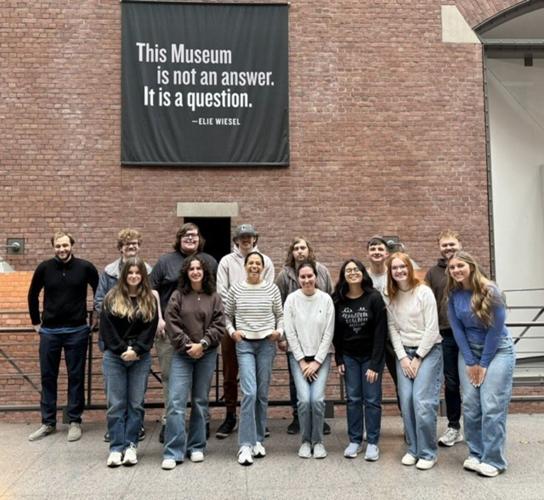
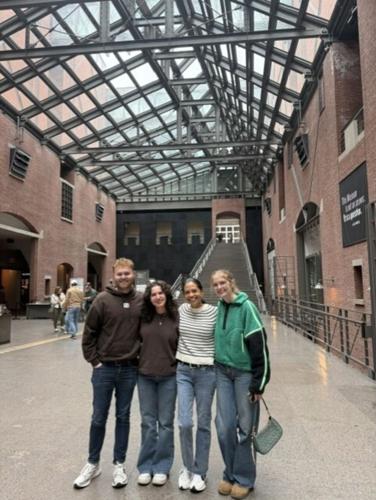
CARLISLE, Pa. — Professor Andrea J. Martin published an essay, “Teaching Law Students to See the Legal Architecture of Persecution,” in eJewish Philanthropy, highlighting an experiential learning assignment she developed for students in her Law and the Holocaust course at Penn State Dickinson Law. The essay examines how legal systems facilitated the systematic persecution of Jews during the Holocaust and the importance of preparing future lawyers to recognize when law is used as an instrument of injustice.
As part of the course, Martin brought her students to the United States Holocaust Memorial Museum in Washington, D.C., where they examined the Holocaust through a legal lens. Using a field guide Martin developed, students traced the progression from legal definitions of Jewish identity to exclusion from professions and public life, confiscation of property, and, ultimately, confinement and deportation. Students also examined the roles played by lawyers, judges, civil servants, and other legal professionals in creating, interpreting, and enforcing discriminatory laws.
The assignment challenged students to consider when participation in an unjust legal system becomes professional or moral complicity. Martin noted, "Many of the officials who acted as administrators of the persecution were highly educated professionals—including trained jurists—who performed careful, competent work. The Holocaust shows that legality and justice are not the same thing and that the rule of law is only as strong as the people who practice it."
The Law and the Holocaust course is a two-credit writing seminar that illustrates Penn State Dickinson Law's commitment to experiential learning and preparing students to approach complex legal and ethical questions with historical understanding and professional judgment.
This content is sourced from
Penn State Dickinson Law
. It reflects the author's views and has not been edited by our newsroom. It may have been generated using AI assistance.