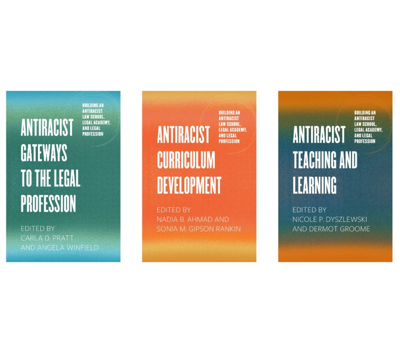

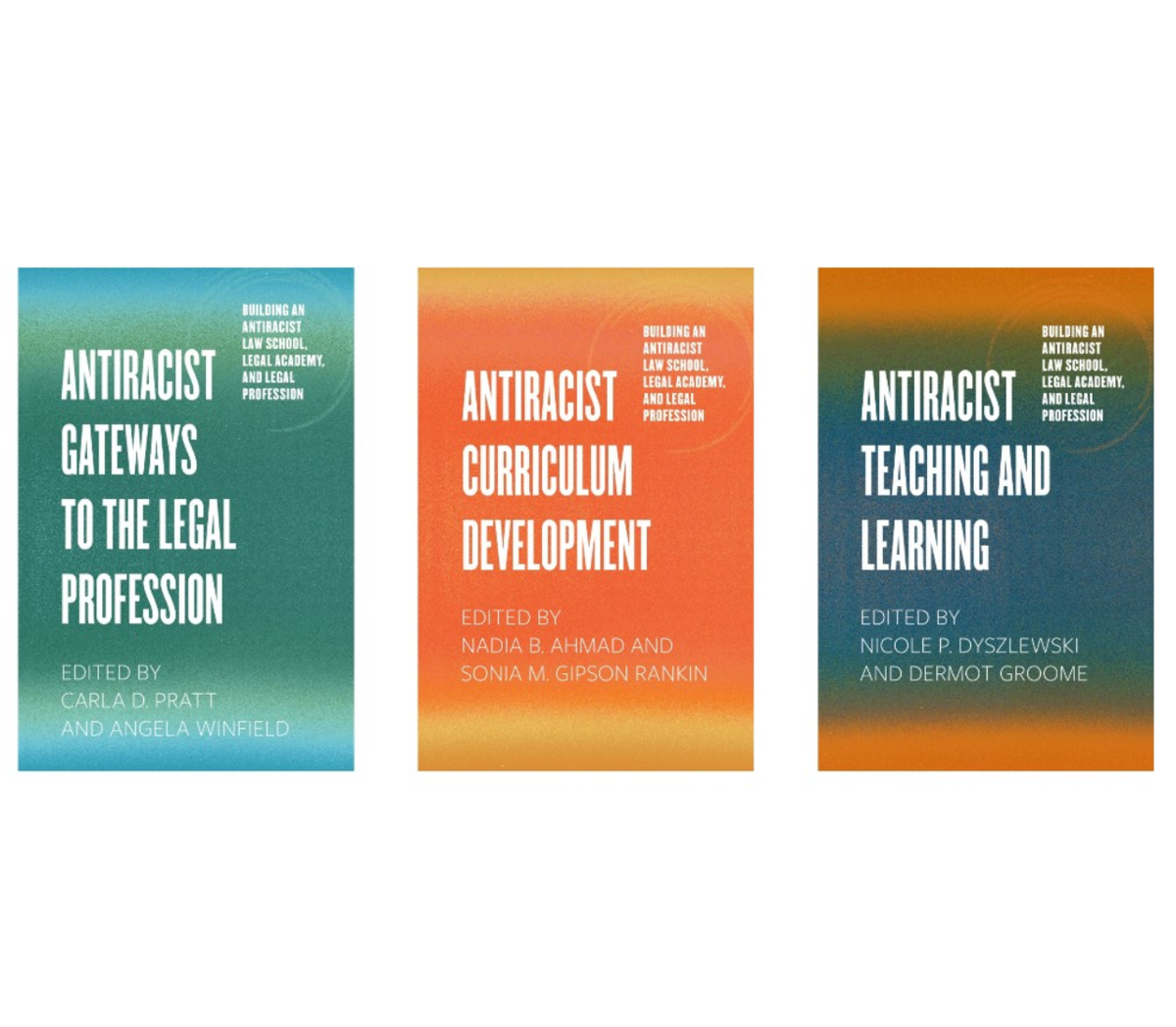
CARLISLE AND UNIVERSITY PARK, Pa. — Nine members of the Penn State Dickinson Law faculty are featured in the first three volumes of the Building an Antiracist Law School, Legal Academy, and Legal Profession, which is being shepherded by the Law School’s Antiracist Development Institute (ADI) and published by University of California Press (UCP).
Antiracist Gateways to the Legal Profession, Antiracist Curriculum Development, and Antiracist Teaching and Learning will publish in early 2027.
The publication marks an exciting milestone for the Law School. Penn State Dickinson Law faculty members were among the first to join the book series coalition that now includes contributors from 76 institutions across the country. Faculty members contributed chapters, some penning more than one, as well as serving as volume editors.
People are also reading…
“Working with our colleagues at Penn State Dickinson Law on this critical series has been incredibly rewarding. We are honored so many of them chose to step forward and include their scholarship in the series, and we cannot wait to see their names alongside our other talented contributors when the volumes are released in January,” said ADI Program Manager TaWanda Hunter Stallworth.
ADI Executive Director Danielle M. Conway, a distinguished professor of law, is the series editor for the 10-volume series, which includes more than 120 colleagues from the legal academy, legal profession, and adjacent organizations. The release of the first three volumes coincides with the Association of American Law Schools (AALS) annual meeting, where Conway will preside as president with her chosen theme of “Emancipate. Academic. Freedom.”
Here is an overview of the contributions from the nine Penn State Dickinson Law faculty members in the first three volumes.
Danielle M. Conway
As the series editor, Conway has helped shape and refine every volume of the series. She offered feedback on each book’s chapters, concepts, and structure. Additionally, she decided where to cross-reference the volumes, bringing cohesiveness and big-picture perspective to each one.
Amy C. Gaudion
Gaudion has two chapters featured in Antiracist Curriculum Development: “Identifying Antiracist Curricular Touchpoints: Embracing Bureaucracy to Accomplish Change” and “Delivering an Antiracist Curriculum: Equipping Faculty and Staff with the Tools Needed to Become Antiracist Legal Educators.” She addresses the administrative work required to translate antiracist commitments into sustainable curricular change and offers tools to help faculty and staff become antiracist educators through professional development.
Andrea J. Martin
Martin’s chapter, titled “Problem-Based Learning as a Framework for Teaching Bias and Cross-Cultural Competency,” appears in Antiracist Curriculum Development. She provides problem-based learning as a methodology for developing antiracist competencies through student-centered investigation of real-world racial inequities.
Dermot Groome
ADI Associate Director Emeritus Groome is one of two editors, along with Nicole P. Dyszlewski, of Antiracist Teaching and Learning. He also contributed a chapter, titled “Critical Pedagogy and Antiracist Legal Education,” to the volume, in which he reflects on how critical pedagogy can benefit those engaged in antiracist legal education.
Jill C. Engle
Engle, the associate director of the ADI, wrote a chapter in Antiracist Teaching and Learning titled “Reimagining the Law School Classroom: A General Illustration.” She discusses how to use antiracist approaches to break down classroom hierarchies.
Lucy Johnston-Walsh and Medha D. Makhlouf
Johnston-Walsh and Makhlouf, who run Penn State Dickinson Law’s Children’s Advocacy Clinic and Medical-Legal Partnership Clinic, respectively, teamed up to pen “Reflective Practice for Antiracist Teaching and Learning” in Antiracist Teaching and Learning. Reflective practice is a core strategy in clinical legal education, and they argue it could shape students’ professional identity formation and their attention to systemic solutions to legal problems.
Johnston-Walsh also wrote a solo chapter in the volume, “Antiracist Clinical Legal Education,” which examines clinical programming through an antiracist lens.
Julia M. Tedjeske Crane
Crane’s chapter, “Critical Approaches to Legal Research Instruction,” appears in Antiracist Teaching and Learning and explores how law librarians and other legal educators can integrate critical approaches into legal research instruction. Crane is a reference librarian at the Law School.
Mireille Rebeiz
Rebeiz ’24, an adjunct professor who earned her Doctor of Juridical Science at the Law School, wrote “Feedback or Expressions of Bias?” in Antiracist Teaching and Learning, which examines gender, race, ethnicity, and linguistic biases through an intersectional lens in the context of law schools. Rebeiz is also the chair of Middle East Studies and an associate professor at Dickinson College.